














You might have heard of the game known as Dungeons and Dragons, also known as DnD. Dungeons and Dragons is a game that allows you to do nearly anything you want, and it is super easy to get started. Whether you are a seasoned veteran or a player just hopping in, DnD is fun for all. This article will go over how you can be creative in DnD, how to play, accessibility, and the benefits of being part of a campaign.
Creativity in DnD
Dungeons and Dragons essentially has limitless creative potential. There are 2 places where creativity flourishes in DnD; the player’s character and the Dungeon Master’s (aka the “DM”) campaign.
Your character is typically the first thing that you’ll create in DnD. There are near infinite possibilities to explore when it comes to making a DnD character, but I’ll give the broad picture. The main things you must do when making your DnD character is choosing your character’s class and race. Classes include fighter, wizard, rogue, barbarian, monk, and many more. Each class gives your character specific abilities and stat buffs (i.e. ability enhancements). An example of this would be if you want to have a character who is based on a gladiator, you’d probably want your class to be a fighter. The second major area is your character’s race. Races in DnD include human, dwarf, elf, and a few more. Races provide smaller stat (ability) advantages than classes and mostly serve to add depth and potential backstory to your character.
Backstory is also a major way to use your creativity to add depth to a character. While not necessary, adding backstory to a character along with a race and class that connect to the backstory are amazing ways of using your creativity in DnD. An example of a character with a backstory could be a retired military general who once controlled the largest army in the lands and is now roaming, searching for his next adventure. To tie into this backstory you could make his race a human and his class a fighter. This is an example of a character whose class and race directly tie into a backstory.
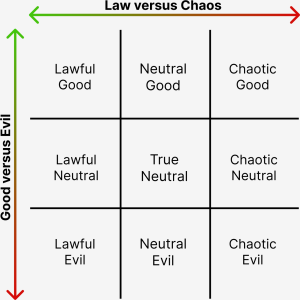
Lastly, alignment is a major part of DnD characters if you want to go deep into their backstory. Alignment tells the DM (who runs the game and will be talked about more later on) (and can remind you) what your character’s relationships with the outside world are. An example of an alignment could be “chaotic good”. A chaotic good alignment could be used for a character who is generally good, but does so without following the laws of the region. An example alignment for our military soldier character could be lawful neutral. In this case, we could say that while he does follow the laws, he doesn’t always do what could be considered the “good” thing.
The aforementioned creativity is not relegated to just my point of view, either. Upon being asked “on a scale of 1-5 how much creativity would you say DnD gives you”, a student WHAT GRADE?? from Methuen High School responded, “A 5! I think DnD can help someone gain a narrative advantage. It’s helped me even now on things like narrative assignments”. Then, after being asked if he enjoys this creativity, he responded with “why wouldn’t I enjoy the creativity?”
As for character diversity, I interviewed two students so that I could compare their most recent characters. Both were asked, “can you give me a rundown of your most recent character?” A FRESHMAN (??? – VERIFY) currently attending Greater Lawrence Technical School, responded by saying that “[his] most recent character was Clink the Kenku rogue. He is a silly guy with the mind of a parrot.” Another student,GRADE?? currently attending Methuen High School responded by saying that “[his] most recent character was a dragon born, barbarian. I focused on strength and charisma to help inside and outside of battle.” Despite both of the participants being the same age and playing the same game, they had very different characters, going to show the potential creativity in DnD.
Campaigns are also a creative component of DnD. Campaigns are the adventures that your Dungeon Master, the person who runs the game, creates and puts the players through. Campaigns can either be preset, meaning that they were created previously or by someone else and that your DM is just using it, or they can be homebrew. A homebrew campaign is a campaign that was created by your DM. Homebrew campaigns are some of the most fun due to the unlimited amount of possible stories and challenges. For example, one homebrew campaign might be a suspenseful murder mystery where the players must find the killer before they get killed and another campaign could be the players banding together to defeat a great evil. Homebrew campaigns are nearly limitless in their possibilities and one of the most popular ways to play DnD due to this.
How to Play DnD
Dungeons and Dragons is a fairly simple game to play, but it has depth. The complexity of the game is entirely dependent on how deep you as the player want to go. If you want to go extremely deep and make a character with a fully fleshed out backstory then you can do that and it’ll be fun, if you instead want to make a joke character and just have a good time then you can do that as well.
DnD can be played either online or in-person. There are several websites such as Roll20 and DnD Beyond which provide the experience of DnD without the need to go somewhere to meet up with people. The largest difference between online and in-person DnD is that if you are doing it online, then your entire campaign could be deleted if your DM doesn’t save or the server crashes. It is for these reasons that it is typically recommended that you play DnD in-person rather than online.
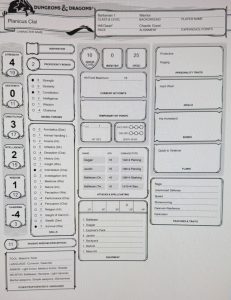
The biggest thing that drives people away from DnD is the team sheet. A team sheet is where all of the information for your character is located, including backstory, stats, and spells (if your class can use magic). In reality, the team sheets are quite simple. There are plenty of online tutorials for how to fill in a team sheet using your class, race, and a few simple calculations. Apart from that, the backstory is entirely up to you and your list of potential spells are decided by your DM for you to pick from.
In terms of actual gameplay, DnD is really quite simple. Your character, along with the rest of the party (party referring to the group you’re playing with) is sent on a quest by the DM. Your DM will explain the backstory, where your characters are, and what they might have been told to do. After that, anything is possible. All of your party’s decisions from the start onward compound, making a story and adventure that can’t be planned in any way, shape, or form. Your DM might lay the groundwork for a story, but nothing is holding the players to that pre-existing story. For this reason, Dungeons and Dragons truly is a game where anything is possible.
Due to how important creativity and the decisions made by the party are in DnD, you can’t ever really explain how to play. Of course you can explain how to start making your character and where to make it, but you can’t ever explain exactly how to play. You can play anything from a dwarven wizard all the way to a human warrior, your character’s story is entirely in your hands.
Accessibility
DnD can be played both online and in-person. If you want to play online, then you would select a website to play on, a campaign, and simply begin. Instead, this section will mostly be talking about the accessibility of the more popular option, that being playing in-person.
The starter kit sold for the game typically costs around 20 dollars. Despite this, the starter kit is rarely necessary. While it certainly contains important instructions along with a pre-made campaign, most DMs will already have these resources for the party prior to the game. The starter kit also includes character sheets, however, most DMs allow for you to use an online character sheet which can be set up on a website. Of course some people like physical character sheets, in which case, you might need to buy or print the sheets from a store or with a starter pack.
The biggest hurdle in DnD is acquiring the necessary pieces. These pieces are used to represent the characters and enemies on the map. Most DMs will already have these pieces and will lend them to their players for the campaign. However, there are also some people who prefer to bring their own pieces, an option which is perfectly fine.
The DM also requires a map for their campaign. The map represents the area that the players are moving around on and is incredibly important. Some maps are universal, and can be used for multiple different campaigns. These maps include things like the interiors of houses and paths that the party could be walking along. There are also very specific maps that can only be really used in one campaign.
Overall, most accessibility obstacles focus on the DM. The DM is responsible for bringing in maps, the campaign, and game pieces. The main reason that most people don’t play DnD is because they don’t know anyone who plays. Without an in-school club or connections with the DM of a private campaign, most people are unable to even try DnD in the first place.
The Benefits of Being Part of a DnD Campaign
There are many benefits of being part of a DnD campaign. The largest benefit that I will be covering in this section is primarily focused on playing DnD in high school.
Dungeons and Dragons forces its players to work together and use their unique skills in tandem with each other in order to make their way through the challenges of the Campaign. This, in many ways, could help you in high school and potentially even in college and future jobs. In these higher levels of school, communication and working together is an essential part of doing well. DnD emphasizes this skill in particular above any other. In order to beat a campaign, you must work together with your fellow players, otherwise it will be a truly difficult game.
Along with this, I asked fellow players if they “would say that DnD club has improved their experience in high school?” The player from Methuen High School responded, “yeah I enjoy going to the DnD club [it] has helped me make friends with people I may have not met [otherwise]”. And the player from GLTS agreed: “Yes. I’ve made new friends and it gives me something to look forward to each week”.
Both of these responses reflect the same thing: DnD allows for you to meet and work together with other students that you may not have met otherwise. It gives you something to look forward to along with helping you learn how to work together with a group of people in order to achieve the best outcome.