






















Hate symbols are just pictures, right? Just like how slurs are “just words,”stealing is “just borrowing,” and murder is just liberating someone from a mortal state. Right?
The purpose of hate symbols is to dehumanize, insult, and intimidate people or groups. Though there are hundreds of symbols, some have become especially infamous throughout history. And unfortunately, despite today’s common knowledge of the meaning behind them, they are still sometimes used in an attempt to terrorize others. In this article we discuss the five common hate symbols, although others exist, and the laws that apply to such speech.
Laws against hate speech and symbols:
In the United States, there are no laws that outright prohibit hate speech or the use of hate symbols, unless said symbols are used to threaten or intimidate. However, outside of the US, several countries have laws against any hate speech regardless of whether it can be proven to threaten or intimate, including Canada, Germany, India, Australia and Denmark. The penalty for using these symbols varies by country, but usually consist of fines and a few years spent in prison.
Furthermore, countries such as Argentina, Mexico, Colombia, Spain, South Africa, and Turkey also have laws against racial profiling and discrimination based on race which include penalties and the possibility of jail time.
Is hate speech protected by the first amendment?
Generally, yes. According to Thefire.org, a website that is dedicated to protecting every American’s right to free speech, “the first amendment recognizes that the government cannot regulate hate speech without inevitably silencing the dissent and dialogue that democracy requires.” In other words, what would be considered hateful to some is a word or expression that could be used daily by others; what is vulgar to one person could be an innocuous term of endearment to another. However, there are a few exceptions; if the hate speech leads to a threat, violence, or a hate crime, then it becomes illegal.
Are hate symbols protected by the first amendment?
In cases of public self expression (i.e. wearing a swastika armband, having a burning cross or another hurtful symbol tattooed on one’s body) the use of hate symbols is considered legal, as long as it is kept to oneself and does not by itself lead to violence. The use of hate symbols usually only becomes illegal when it constitutes a threat to others whether by personal violence or property damage. For example, placing an object or symbol of hate on private property (like setting up a burning cross in someone’s backyard) would be considered illegal as it is considered a threat and it criminally damages private property.
Additionally, some lawmakers are working to limit hate speech while still adhering to the first amendment. Teach Democracy says “[they] have been crafting statutes and making certain kinds of hateful acts, like Klu Klux Klan-style cross burnings, illegal.” Certain cities are taking the same route, outlawing hate symbols in the form of graffiti by considering it to be disorderly conduct and resulting in a misdemeanor. The criminal act here is “disorderly conduct” which some cities define as the use of hate symbols on public property.
The Burning Cross

The burning cross was a symbol used by the Ku Klux Klan, a Christian extremist and white supremacist hate group. The use of the burning cross is used to target Jews, Catholics, people who are LGBTQ, and people of African descent.The KKK was most active during the 1920s randomly whipping, lynching, and terrorizing people of these groups, but its impact can still be seen today. The burning cross itself, which the KKK was most notorious for, was meant to be a symbol of racial or religious intimidation, often being lit in public places in an attempt to spark terror.
While actual cross-burnings are nowhere near as prevalent today as they were decades ago, the prevalence of burning crosses on tattoos has skyrocketed.
The Nazi Swastika
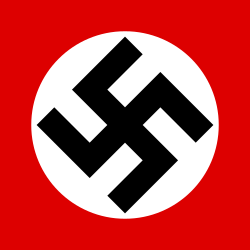
Arguably one of the most well-known hate symbols that exists, the swastika was used by Nazis during the Holocaust in 1933. However, it was not only used by the Nazis; originally it was meant to be a symbol of peace. Referred to as “the Manji” by Buddhists, the swastika symbolizes good fortune, well-being, and following in the Buddha’s footsteps. In Buddhism, a left-facing swastika is more commonly used, while a right-facing one is more often used by the Nazis. The Nazi Swastika is meant to symbolize hatred and hope for extermination of the extensive list of groups that the Nazis oppressed, including Jewish people, political rivals, homosexuals, and Romani people.
The Swastika is a common symbol for modern shock graffiti and vandalism, but considering all of the hatred it represents, it shouldn’t be used lightly. Similar to the burning cross, it is commonly seen in tattoos.
Holocaust Expropriation Triangles
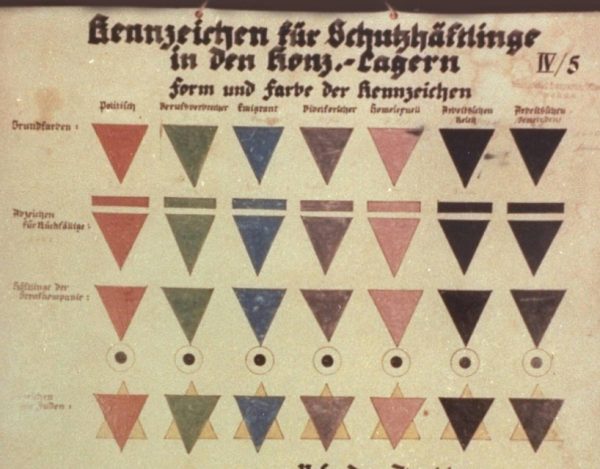
Similar to the swastika that was previously mentioned, expropriation triangles were used by the Nazis during the Holocaust to demean and identify people the Nazis hated. These triangles were given in different colors to different people who were considered “unclean” to the Nazis. Different colored triangles had different meanings. For example, yellow triangles were intended for Jewish people and pink triangles for homosexuals.
Nowadays, these triangles used to take power away from the symbols. People might wear these symbols to show that their membership in groups that would have been targeted, or to show support for those marginalized groups.
The Confederate Flag
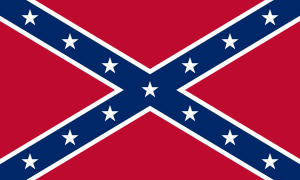
The Confederate Flag was mainly used by Southerners who wanted to secede from the Union during the American Civil War in 1861. It doesn’t always represent hate speech, but more often than not, it does when you consider that one of the prevailing reasons motivating secession was the desire to keep slaves.
The confederate flag is still used today, though it has become much less common and much more controversial. Some believe it represents racism, while others (mainly older Americans) believe it represents heritage and honor to the generals who fought in the civil war. According to Yougov.com, “For a plurality of Americans, the Confederate flag represents racism (41%). But for about one-third of Americans (34%) — particularly adults over 65 […]the flag symbolizes heritage.”
The Symbols of the Aryan Brothers
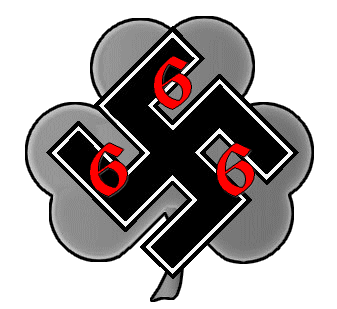
Started in California State Prison, the Aryan Brothers is a gang of white inmates who fought against other gangs found in the prison. Created to protect members against other groups, the group began to “not care about anyone except the [Aryan Brothers], and became a white racist group” (FBI). The term “aryan” refers to what they perceive as “the perfect race”, which would be considered blonde, blue-eyed, white, and a gentile. They decided to refer to themselves as Aryan, to show their beliefs and the self-proclaimed authority that they had over the other gangs in the prison.
To join the group, prisoners originally had to be Irish. To become a member officially, advocates would have a vow that they must recite:
“I will stand by my brother.
My brother will come before all others.
My life is forfeited should I fail my brother.
I will honor my brother in peace and war” (FBI).
If any of them makes a wrong move, then they would be killed, raising the stakes as they did the inhuman tasks that they put upon themselves. Below is a list of symbols that may be associated with the Aryan Brothers.
- The shamrock and swastika (occasionally with the number 666).
- Many different number symbols depending on where you find the gang. This can help identify them and also install their slogan into others .
- Various hand signs that may represent a number or be a reference to Hitler.
It is important to know that just because you see a number that may be considered a symbol for the gang does not mean that the person who has it is a member.
Hate symbols are never okay to use. While one might think that it is just a drawing, a hand gesture, or a word, history makes it so that we can’t do anything with them without causing public fear or intimidation. By being educated about significance and history of these hate symbols, we can create a safe environment for all people, no matter their culture, gender, or race.