



















History is one of my personal favorite subjects. I’ve always been curious about why the world is shaped the way it is, and history class helps me answer that question. When it came to history, I used to think there was a single, agreed-upon curriculum. For example, with AP courses everything is taught concordantly because we all take the same exam. But I realized this was not true when I was learning about the American Civil War in history class.
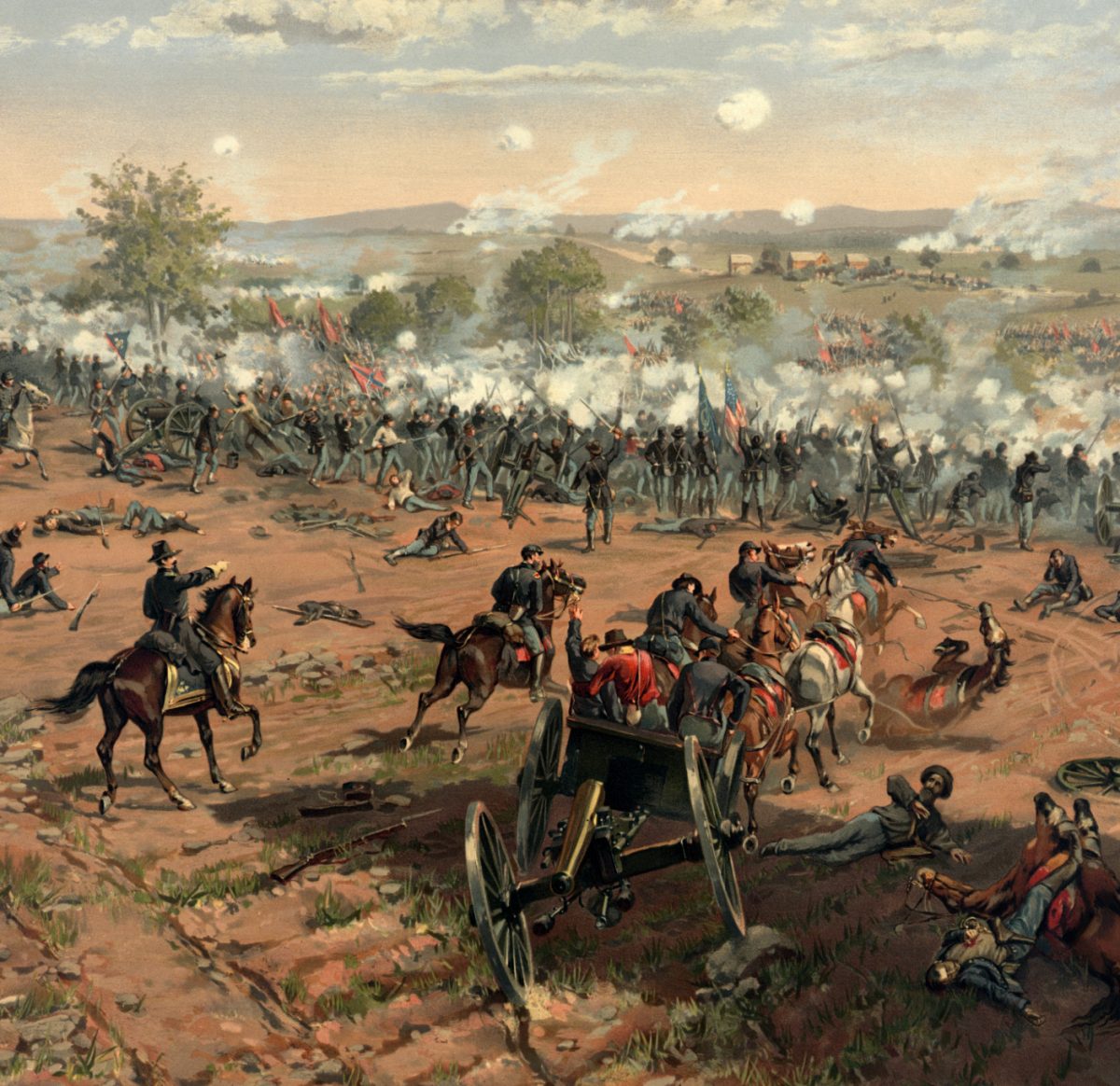
During class, we were having a class discussion about the Civil War and many of my peers made throwaway comments about how in the South and North the war is taught differently.Some said that students in the South learn a skewed version of the Civil War, one where slavery was not the central cause of why they fought in the war, but that it was more in the name of upholding states’ rights.
My peers contrasted this to North, who “had the story straight.” Students in the North “rightfully” learn that the Confederacy seceded and took arms up against the country MAINLY to preserve slavery!
But these comments also made me wonder: what other things in history are taught differently across the country that I may not realize? I could learn about the same historical era or event as somebody else in another state and we may have a completely different takeaway due to the way we learned it. It’s completely possible!
Once I came to the realization that history is taught differently from school to school and state to state, I wondered: how do we decide what a correct and well rounded explanation of history is? What if one educator’s idea of the “correct” history is very different from another’s? Is anybody correct?
In order to answer that question, we must talk about the concept of historiography. Historiography is the study of how history is written and interpreted. It closely explores how and why historians choose to present events in certain ways, examining the decisions behind which details are emphasized, which are omitted, and why one interpretation may be favored over another.
These choices reflect broader historical interpretations that influence how students learn history in classrooms across the country. In the United States, there is no single agreed-upon history curriculum.Each state establishes its own standards for what students should learn in social studies and history, typically through committees composed of educators, curriculum specialists, academics, and community members.
These recommendations are then voted on by the state board of education. Because each of the 50 states set their own criteria, that means there are 50 different visions of what history students should learn.
After states adopt standards, local school districts often decide how to meet them: which textbooks to use, what supplementary materials to choose, and how much emphasis to put on specific topics.Some states approve lists of textbooks districts must choose from, while others allow local districts to choose freely. As a result of each state mandating different content, textbook publishers often produce multiple versions of the same textbook customized to meet those varied requirements.
With this decentralized system, history textbooks can tell different stories in different places. Furthermore, it creates possible opportunities for political, cultural, or ideological influences to shape what students learn. This flexibility explains how curriculum decisions are made broadly.
History Curriculum at CCHS
To better understand how these choices are made in my own community, I interviewed the head of the history department at Central Catholic, Mr. Lynch, about how our curriculum is developed to provide a firsthand look into the history education students receive at Central.
How is the history curriculum at our school chosen and who is involved in deciding what topics are included?
We are in a unique position at Central Catholic, where we are not a public school, and we get to chart our own course, which is a really good position to be in.
We are not beholden to state standards, or national standards. We do use those as a guideline when we develop our curriculum. So both in terms of the topics that we teach, as well as the sort of basic core social studies skills, those are the standards and we draw from those. With choosing these topics, our department works within our three-year requirement so students have a well-rounded view of as many topics as we can cover, and we have taken some initiatives in the last five years to broaden those topics. For example, in the last five years, we brought work on Latin America, Africa, and the Caribbean into the freshman curriculum. We have always engaged with these regions, but we expanded our focus to acknowledge that many of our students are deeply connected to them.
Since our school is not bound by state curriculum standards, how would you describe the flexibility you have when teaching history here and can you go beyond the school’s self-set requirements?
One of the things I love about teaching at Central Catholic is we have tremendous flexibility. If you talk to anybody in public education, they are often frustrated by the level of which they are constrained. It really doesn’t exist here.
So if I have something that’s really important to me and I think that it’s really important for my students to be able to do or learn; I can take that little side trip and explore it. All while not having to worry about teaching to a state exam or the idea of “it’s not in the curriculum, therefore, I can’t teach it.”
How do you determine what qualifies as a well-rounded historical narrative, and what elements make a story feel complete and effective?
Getting multiple perspectives on an event is always the goal, and I like to think it’s something that we do a good job of. Every topic I’d like to think about, we give multiple perspectives on the topic, and discuss how people felt. You and I are going to study one coming up in the 1920s. It’s the era of flappers, jazz, parties; but it’s also an era of extreme nativism and an era of extreme racism. We try to make sure we’re looking at an event in multiple ways. It isn’t possible in every single historical event, but we work to find a way to bring in those other voices and perspectives that doesn’t feel forced.
Are there any topics with perspectives that you believe are important but difficult to include due to time constraints?
We have to pick and choose our battles on where we go the deepest, which is the hard part about history.
There’s always trade-offs because every year our curriculum gets longer. And no one wants to extend the calendar. So, it’s really just a matter of getting multiple perspectives in and I think we do a pretty good job at that.
As a teacher, how do you navigate teaching, controversy, or sensitive subjects like slavery, war, political conflict, or racism?
I was once a junior year religion teacher and there are many awkward conversations that sometimes happen within a religion class because we’re talking about real life situations. I do not feel a need to shy away from teaching about the good and the bad of history.
My goal is to help students understand what actually happened from as many perspectives as possible. There’s a great book called Lies My History Teacher told me. One of the lines that really stuck with me was “the antidote to ‘feel bad’ history is not ‘feel good’ history.” In other words, feel bad history is, “here’s everything everybody in the past did wrong. What a bunch of losers, right?” That’s not accurate. Then there is “feel good” history: “Everyone was heroic, everything we’ve ever done is reasonable. Everything we’ve ever done was unselfish.” That’s also not accurate.
Seeing things in terms of bad guys and good guys doesn’t help. I think we should try our best and look at what happened and how stakeholders on different sides either benefited from it or did not benefit from it. Additionally, it is very important to think about those voices at the time as well and how they felt.
What role do parents and administrators play in shaping or limiting what is taught in history classes if at all?
If a parent had a concern with a particular topic or something happening in class, I would certainly have a conversation with them. I’ve been department chair for many years, and I don’t think I’ve had many conversations with a parent where they wanted me to change, remove, or add anything I taught as a department chair. As for administrators, all of our curriculum is approved by them. I, the department chair, and teachers write the curriculum as a group. And because history is a living document, we make changes every year. There are times where as a chair, I get teachers together to talk about what’s being done in certain areas. We do that all the time. Sometimes we ask: Do we need to bring in more of this topic? Is it time to let this other topic go? There are a couple of academic deans involved too, and the principal (Mr. Murray) would have the final say, but the decisions are mostly left up to us: the academic deans, department chairs, and teachers.
How do you encourage students to think critically and with nuance about historical narratives rather than just accepting a single version of history?
Doing that is my goal and I hope it is landing with students. I want to help students understand how everything was involved. I try to emphasize the idea that everyone in the story is an actor, not a prop. When you’re doing the narrative of history with all the groups and people involved, the story is inevitably told in a simplified way because you can’t teach every detail. But you want to make sure that nobody appears as a prop in the play and fades into the background. We don’t want anybody to appear like a wooden tree onstage while all the action happens elsewhere. To avoid that, we try to present as many perspectives on events as possible and help students understand it in that nuanced way. Often, your teachers will ask questions like “what do you think the most significant outcome of [blank] event is?” or “what lesson does this event teach?” That gives students the chance to say, ‘this person had it right’, ‘this person had it wrong.’ It helps students engage with history and recognize it is very complex.
How do you think historiography influences how the department approaches teaching history?
The best way I can describe historiography is that it is the study of how we study history. Here’s an example. When I was in high school, I distinctly remember a lot of debates over whether the Civil War was about states rights or the differences between the North and South, and there was a de-emphasis on slavery. And I actually believe the people who were teaching that were well meaning and were not attempting to de-emphasize the notion of slavery.
The way in which history is presented is always going to be influenced by the context, the era, and the people who are telling the story. What we try to do in our department, and I think what most teachers try to do in the world is try to look at what happened and tell you the truth about what happened. And I think if there was specifically a Central Catholic version of historiography its looking at a story, saying: “Okay, what happened here?” and making sure the least favored gets included in that story.
For example, if we were learning about Irish immigrants being discriminated against, because they’re Irish and Catholic, that’s absolutely the least favored, you know. Events like that work that concept in. One of the great freedoms of working here, is that in a lesson I can say, “Hey guys, this is the least favored. These people we’re talking about right now, these are the least favored.”
Why History Curriculum Matters
History education in the United States isn’t monolithic. What students learn in one classroom might differ (sometimes substantially) from what students learn just a few states away.
Recognizing this complexity highlights why it’s important for students (and everyone) to seek knowledge from multiple sources, including but not limited to: history textbooks and class lessons, primary sources and historical documents, scholarly books and reputable websites, and simply have discussions with people who have different perspectives than your own.
Sometimes important details that would provide a well rounded understanding of history are left out of lessons because they’re controversial, it flew over the radar of school boards, admin & committees, teachers had a different approach or even simpler: there simply wasn’t enough time to explore them in class.
That’s okay, as long as we don’t stop asking questions. Exploring history beyond what’s handed to us in a classroom is fun, enriching, and essential to understanding the world around us.
Because at the end of the day, a history class can only teach you so much about our world. You have to step out into the world and learn some things yourself!